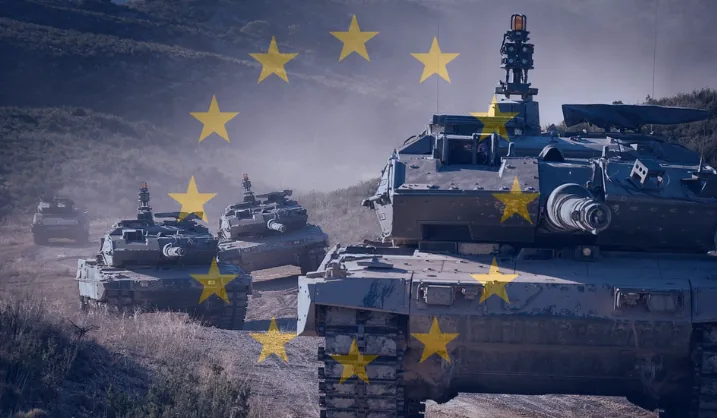
Europe is entering a different phase in terms of defence. It is no longer simply a matter of increasing budgets, but of rebuilding industrial capabilities, securing supplies, coordinating procurement and reinforcing strategic technology sectors. In 2026, defence has ceased to be an exclusively budgetary or military matter and has become a vector of industrial policy, strategic autonomy and investment reordering.
For companies, funds and analysts, this has one clear consequence: the industrial ecosystem linked to defence, security, materials, logistics, electronics, software and advanced components will gain prominence in Europe. This is not only about major contractors. The transformation also affects suppliers, subcontractors, technology integrators and associated supply chains.
The budget leap is no longer a hypothesis
The most visible change is the financial effort. The European Parliament has summarised that, according to data from the European Defence Agency, meeting the new objective would imply very significant increases in aggregate spending and a change of scale in the European budgetary conversation.
EU Member States’ defence budgets – European Parliamentary Research Service
Beyond the debate over percentages, what matters is that the strategic direction is clear: Europe acknowledges it needs to invest more and better in defence capabilities. This not only drives budgets; it drives industrial demand, financing, coordinated procurement and new technological priorities.
From geopolitical urgency to industrial policy
The real change is not in the headline on spending, but in the evolution of the approach. The EU is progressively building a more articulate defence industrial framework. Various analyses suggest that the European defence industry programme is set to complete the Union’s industrial and financial toolbox in this area.
The European Defence Industry Programme – IAI
This means that defence is being integrated into a broader logic that connects:
- public procurement,
- technological innovation,
- strategic autonomy,
- supply chain,
- access to raw materials,
- and industrial consolidation.
In other words: Europe is no longer just discussing how many systems it needs, but also who manufactures them, with what components, with what external dependency and under what industrial architecture.
What this means for the private sector
The first reading tends to focus on large defence groups. But the real effect is broader. An expansion of Europe’s defence industrial base creates opportunities across multiple segments:
1. Electronics and semiconductors
Sensors, communications, guidance, control and critical systems depend on advanced electronics and reliable components.
2. Materials and raw materials
Defence competes with other sectors for metals, technical materials and high-specification supply.
3. Software, data and cybersecurity
The integration of defence, digitalisation, AI, automation and cybersecurity will continue to increase.
4. Advanced manufacturing
Flexible industrial capabilities, precision, machining, robotics and quality control gain relevance.
5. Logistics and maintenance
Sustaining military and industrial capabilities requires logistics networks, maintenance and operational resilience.
Therefore, the opportunity is not limited to the “defence” sector in the traditional sense. It extends to a significant part of the industrial and technological fabric.
The major bottleneck: supply chain and execution capacity
One of the most serious challenges is not approving budgets, but transforming money into real capability. That depends on plants, suppliers, components, certifications, skilled personnel, raw materials and production timescales.
Here one of the major friction points emerges: the industrial reinforcement of defence coincides with other transitions that are already placing pressure on materials, energy and manufacturing capacities. Defence, energy transition, digitalisation and infrastructure are partly competing for the same industrial inputs.
That requires looking beyond the final contractor. A company seeking to understand the opportunities of the new European cycle must analyse the full chain, not just the political headline.
The connection with critical minerals and strategic autonomy
The relationship between defence and critical minerals will become increasingly important. The very evolution of European and German industrial policy points to growing concern about securing strategic raw materials for sensitive sectors. In this sense, the defence debate cannot be separated from the debate on materials, semiconductors and supply resilience.
What is interesting is that this connection makes the industrial agenda more complex: it is no longer enough to have a budget or technological capacity. Access to inputs, transformation capacity and reduced exposure to external disruptions are also needed.
Dual-use innovation: the great silent opportunity
One of the least visible but most important effects of this new cycle is the expansion of dual-use technologies. Many capabilities driven by defence have civil or industrial applications in parallel:
- drones and autonomous systems,
- machine vision,
- secure communications,
- advanced analytics,
- cybersecurity,
- advanced materials,
- simulation and control software.
This broadens the field of opportunity for companies that do not consider themselves “defence” companies, but do work on technologies that can be integrated into that ecosystem.
What a company or investor should watch
If an organisation wants to position itself for this change, it is worth monitoring several variables:
- public investment programmes and timelines,
- industrial sectors with the greatest pull-through effect,
- dependence on critical raw materials and components,
- opportunities in dual-use technologies,
- industrial scaling capacity,
- and real margin of entry into already consolidated chains.
The key is not to follow the political noise, but to identify where sustained demand will emerge, which segments will need more suppliers and which capabilities may become bottlenecks.
A new era for European industry
Europe is opening an era in which defence will no longer be merely a necessary expense, but a partial driver of reindustrialisation, innovation and strategic reorganisation. That evolution will have effects on investment, technology, industrial employment, public-private cooperation and supply chains.
For companies, the message is clear: European defence is ceasing to be an isolated market and is becoming a space of broader industrial transformation. Those who analyse it in time will be able to identify real opportunities. Those who view it as a purely conjunctural phenomenon risk arriving too late.