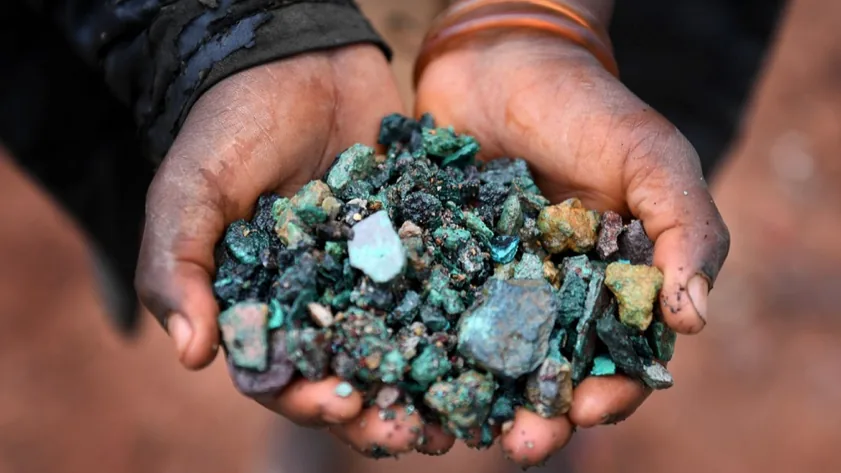
The conversation on critical minerals no longer belongs exclusively to the energy domain. In 2026, talking about rare earths, lithium, copper, nickel, graphite or gallium means talking about industry, automotive, defence, semiconductors and strategic autonomy. Supply security has become a first-order geoeconomic variable, and companies that depend on components, technology or advanced manufacturing can no longer treat it as a secondary issue.
For years the debate focused on the energy transition. Today the picture is broader: electrification, artificial intelligence, increased defence spending and technological rivalry between major powers are all driving up pressure on raw materials that were previously analysed mainly from a mining perspective. The question is no longer whether demand will grow, but which economies and companies will be better positioned to secure supply, reduce dependence and absorb future disruptions.
Why critical minerals have ceased to be merely an energy issue
The International Energy Agency has long insisted that minerals such as copper, lithium, nickel, graphite and rare earths are essential for the energy transition. But the landscape of 2025 and 2026 has broadened the problem: to the demand linked to renewables, batteries and electric mobility, there is now added growing pressure from the digital industry, automation, data centres, advanced electronics and the defence sector.
In 2025, the IEA noted that export controls on rare earths had significant consequences for manufacturing supply chains and that some automotive plants even had to temporarily halt production. Such episodes have served as a reminder that critical minerals now form part of the conversation on industrial resilience.
Global Critical Minerals Outlook 2025 – IEA
Critical Minerals Security Programme – IEA
The conclusion is clear: we are not just talking about resources for the green transition, but about inputs that condition the industrial competitiveness of several value chains simultaneously.
Europe accelerates: from diagnosis to active supply search
Europe’s external dependence on strategic raw materials has ceased to be perceived as an abstract problem. The most recent movement in Germany is a good illustration. According to the Financial Times, German industry is driving an initiative to create a structure inspired by the Japanese model with the aim of securing access to critical minerals and reducing vulnerability vis-à-vis China.
Germany seeks to emulate Japan in shoring up critical minerals – Financial Times
Such initiatives reflect a new reality: access to raw materials is no longer left to the market alone. It is becoming part of industrial, commercial and economic security strategy. For Europe, the problem is not only the concentration of production or processing in a few countries, but the combination of:
- high dependence,
- limited short-term substitution capacity,
- vulnerability to restrictions or shocks,
- and the need to simultaneously feed the energy transition and reindustrialisation.
More demand, more competition and less room for improvisation
The IEA has repeatedly warned that demand for strategic minerals will continue to grow strongly in scenarios involving an expansion of clean technologies. To this must now be added the impact of digitalisation and defence spending. JPMorgan recently summarised this new pressure usefully: not just the energy transition, but also artificial intelligence and increased military spending are reinforcing demand for critical minerals.
The Growing Demand for Critical Minerals – JPMorgan
This has several implications:
1. Competition for supply will intensify
States, manufacturers, funds and large industrial groups are increasingly competing for access to projects, long-term contracts and processing capacity.
2. Risk is no longer confined to extraction
Processing, refining, transport, permitting, investment and intermediate industrial capacity are just as important as the existence of the resource.
3. The problem is not uniform
Each mineral has its own geography, its own market structure and its own vulnerabilities. Copper does not present exactly the same risks as gallium or graphite.
The geopolitics of supply matters as much as the geology
One of the most frequent mistakes is to think that the key lies solely in “where the resource is”. In reality, strategic power often resides in whoever controls:
- extraction,
- refining,
- intermediate transformation,
- the associated technology,
- and the commercial agreements that ensure delivery.
That is why the critical minerals debate is inseparable from great-power rivalry, industrial policy and economic security. The concentration of certain segments in a few countries exposes Europe and other industrialised economies to risks that cannot be resolved with a spot purchase or short-term contracts.
In other words: having the resource available on the market is not the same as having a guaranteed supply.
What sectors have the most at stake
The list of exposed sectors is growing ever longer.
Automotive
Electrification and on-board electronics increase sensitivity to batteries, copper, graphite and rare earths.
Energy
Renewables, grids, storage and electrification depend directly on minerals with complex supply chains.
Semiconductors and electronics
Certain strategic elements are essential for advanced components, sensors and chips.
Defence
The reinforcement of the defence industrial base is increasing pressure on metals and strategic materials.
Digital industry
Data centres, automation, robotics and AI are also competing for materials, energy and components.
The smart response: diversify, anticipate and map risks
For an industrial or technology company, the response does not lie in “securing a mine”. It lies in building a more sophisticated procurement and resilience strategy.
Some sensible lines of action are:
- mapping critical dependencies by component and supplier,
- identifying minerals with the greatest exposure to shocks or restrictions,
- diversifying geographical origins and partners,
- strengthening visibility over processing and refining,
- incorporating geopolitical analysis into procurement and supply chain,
- studying long-term contracts or industrial alliances where it makes sense.
This requires stepping outside the classical view of procurement and elevating the analysis to a strategic level.
Latin America, Africa and Asia will remain decisive
The supply security of critical minerals will be closely linked to several key regions:
- Latin America, for its weight in copper and lithium;
- Africa, for minerals relevant to the transition and industry;
- Asia, for its central role in refining, transformation and manufacturing.
That is why a serious strategy for accessing minerals cannot separate resources, logistics, regulation, political stability and industrial capacity. The raw material matters, but so does the institutional environment and the ecosystem that allows it to reliably reach the market.
This is not a passing trend: it is a new layer of global competition
Critical minerals have come to occupy a central place in international economic competition. Whoever secures access, reduces vulnerabilities and better understands the geography of supply will have a structural advantage in industry, energy and technology.
For companies, this means something simple: critical minerals are no longer a distant topic reserved for governments or large miners. They are a factor that can affect costs, production, investment, industrial planning and competitive positioning.
And precisely for that reason, they require analysis, anticipation and a finer geoeconomic reading than ever before.